
 Mon - Sun 8:00 - 19:00
Understanding the implant procedure timeline is the first step toward taking control of your dental health and your finances. For international patients traveling to Hanoi, the process typically spans two separate trips. The first trip requires a 7 to 10-day stay for the surgical placement of your implants and the fitting of temporary teeth. After a 3 to 6-month healing period back home, you return for a shorter 5 to 7-day trip to receive your permanent, final crowns.
The Reality of Cross-Border Dental Care
Making the decision to travel overseas for complex dental surgery is a significant milestone. We speak with patients from Sydney, Melbourne, and Perth every single day. The story is almost always the same. You are dealing with failing teeth, uncomfortable dentures, or painful chewing. You visit your local dentist, only to be handed a treatment plan that costs as much as a luxury car or a house deposit. Because Medicare does not cover these complex restorative procedures, the financial stress can be overwhelming.
Getting teeth done in vietnam is a highly practical alternative, saving you up to 70% compared to local Australian prices. However, the anxiety of the unknown remains a major hurdle. You are flying thousands of kilometers from home. You want to know exactly what will happen on day one, day five, and day ten. You want to know when it will hurt, when you can eat, and when you can finally smile with confidence.
If you are wondering how long do dental implants take in Vietnam we have the answers. We do not believe in rushing medical procedures to fit a holiday schedule. Biology cannot be hacked. Instead, we use a structured, highly predictable clinical pathway. This is the typical dental implant procedure timeline in Vietnam for international patients. We have designed this guide to walk you through every single phase of your journey, from the moment you first message us on WhatsApp to the day you fly home with a fully restored bite.
Phase 1: Pre-Arrival and Telehealth Assessment
The dental implant procedure timeline actually begins weeks before you ever board a flight. To make your trip to Hanoi as efficient as possible, the initial groundwork is laid remotely.
The Virtual Consultation
When you first contact our English-speaking support team, we will ask you to provide a recent panoramic X-ray (OPG) or a 3D Cone Beam CT (CBCT) scan if you have one. You can easily request these from your local dentist in Australia. Once we receive your imaging, our specialists, led by Dr. Trung and Dr. Hang, analyze your bone structure.
We look at the height and width of your jawbone. We check the position of your sinus cavities and your major facial nerves. Based on this remote assessment, we draft a preliminary treatment plan. This document outlines the exact number of implants you need, whether you require any bone grafting, the total transparent cost without hidden fees, and the specific timeline required for your unique clinical situation.
Planning Your Logistics
Once you approve the clinical plan, we help you align your medical schedule with your travel logistics. We assist you in finding accommodation near our clinic in the Old Quarter, ensuring you have a comfortable place to rest. We coordinate your airport pickup at Noi Bai International Airport so that you feel safe and supported the moment you step out of the terminal. Proper preparation ensures that your 7 to 10-day clinical window is used purely for focused medical care and relaxed recovery.
Timeline
To help you visualize your journey, our experts have mapped out a clear, day-by-day itinerary. This visual guide breaks down exactly what happens from the moment you land in Hanoi to the day you are cleared to fly back to Australia.
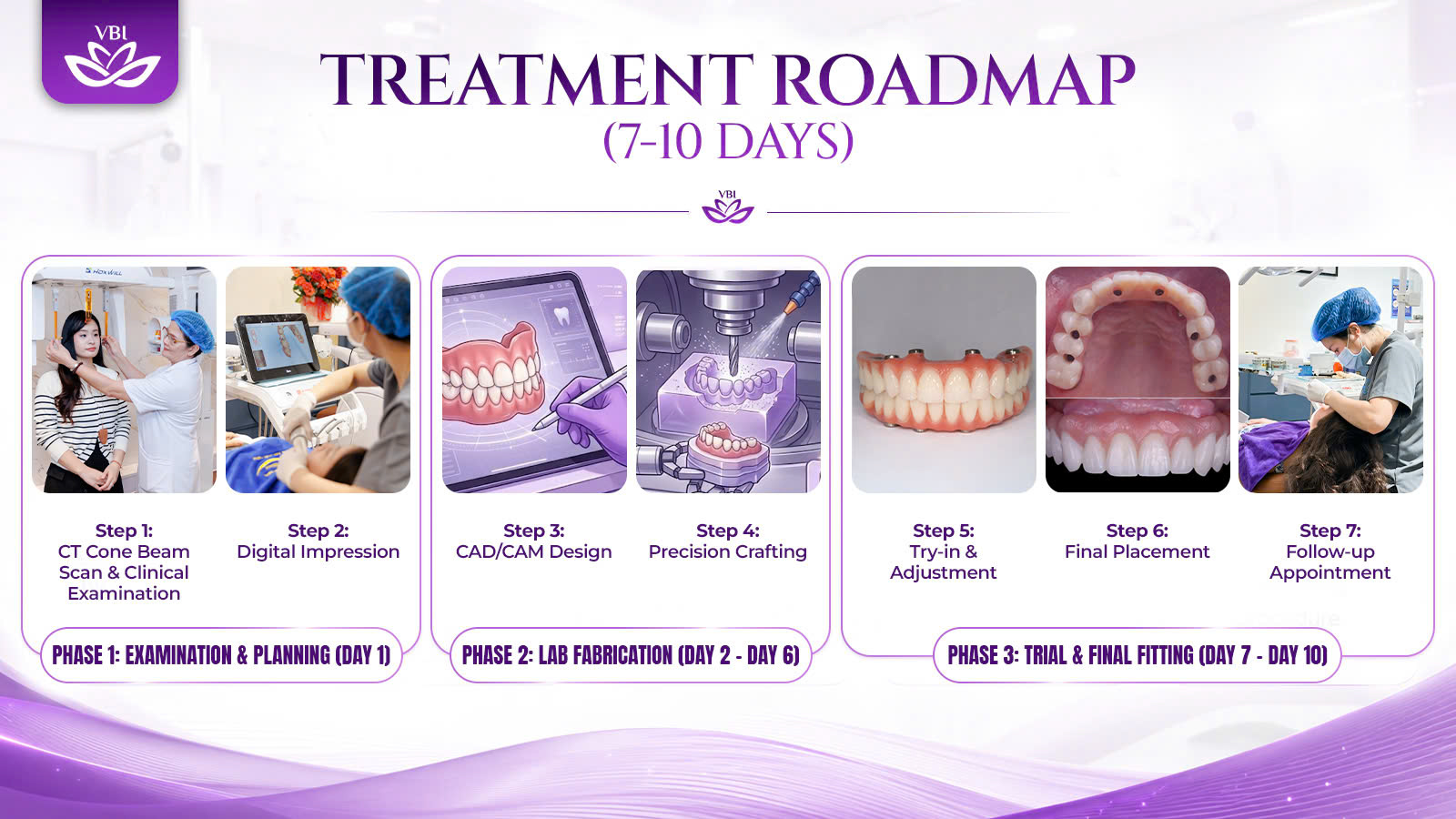
The first trip is the most intensive part of your implant procedure timeline. A minimum stay of 7 to 10 days is strictly enforced. This is not arbitrary. This window gives us the time needed to execute the surgery, fabricate your customized temporary teeth, manage any initial swelling, and ensure you are medically safe to endure the changes in cabin air pressure on your flight home.
Day 1 Consultation
Your first day at the clinic is entirely dedicated to precision diagnostics and finalizing the surgical blueprint. You will sit down with your lead surgeon to discuss your medical history, any medications you are taking, and your aesthetic goals. We then take a fresh, high-resolution 3D CBCT scan to capture the exact, current state of your jawbone.
Instead of choking on messy, foul-tasting impression putty, your first step involves cutting-edge digital mapping. We capture the exact topography of your gums and remaining teeth using a small, high-speed digital wand, creating a perfect virtual model of your mouth in a matter of seconds.
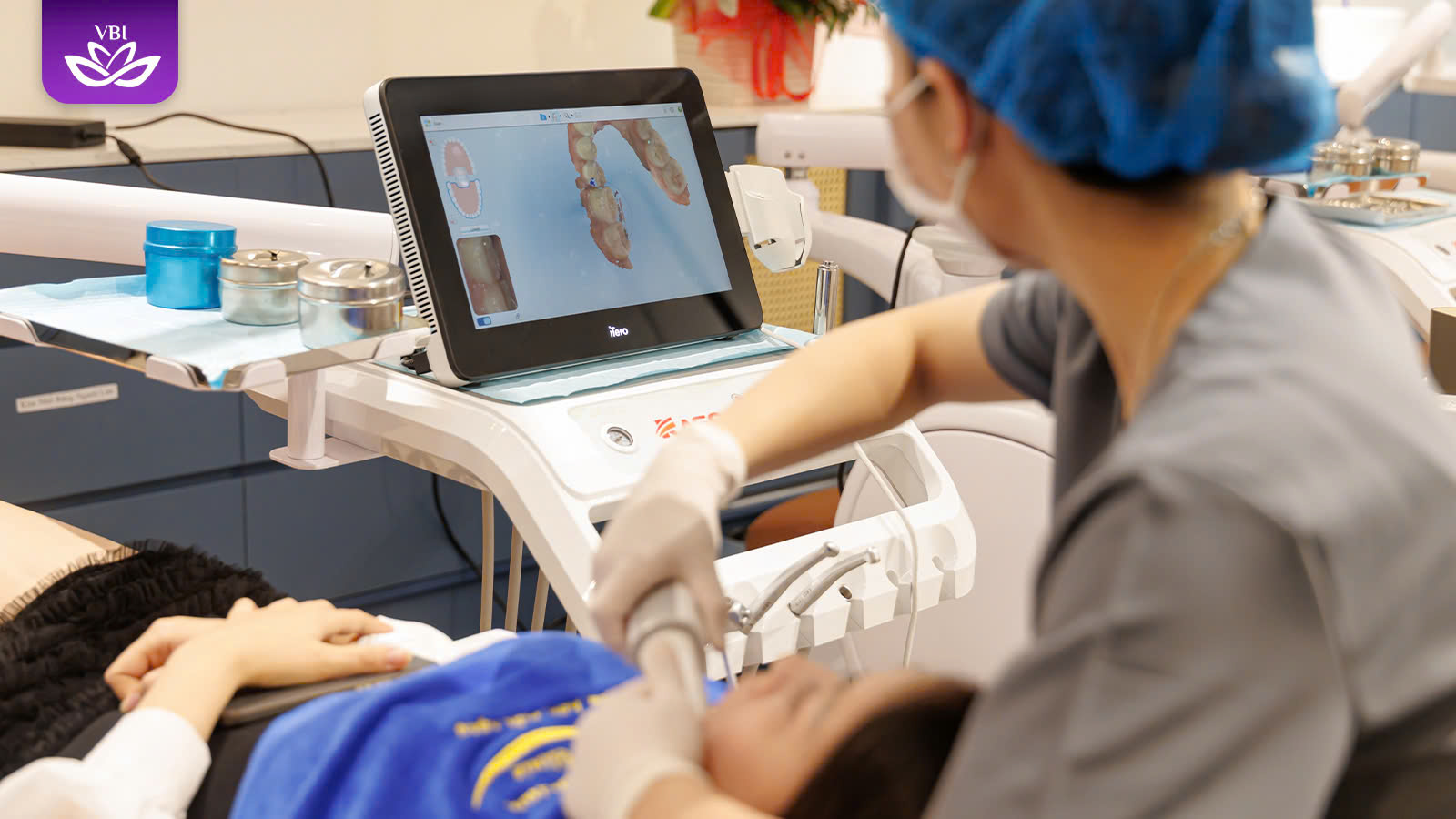
This technology is called a 3D Intraoral Scanner. It works by taking thousands of microscopic photos per second and stitching them together into a flawless 3D computer model. This digital file is instantly sent to our in-house CAD/CAM laboratory. The extreme accuracy of this scan allows our technicians to design surgical guides and provisional teeth that fit with microscopic precision, dramatically reducing the time you spend in the dental chair.
Day 2 to 3: The Surgical Intervention
At this stage of the implant procedure timeline, your physical transformation begins. Depending on the complexity of your case, the surgery can take anywhere from one hour for a single implant to several hours for complex All-on-4 dental implants in Hanoi.
We understand that the idea of dental surgery is intimidating. However, the procedure is performed under deep local anesthesia, meaning you will feel pressure and vibration, but zero sharp pain. Our clinic utilizes advanced Piezotome ultrasonic surgical units. Instead of traditional drills that can traumatize surrounding tissue, ultrasonic surgery uses micro-vibrations to gently separate bone. This preserves your delicate gum tissues and blood vessels, significantly reducing post-operative swelling and pain.
During the surgery, the titanium implant posts are carefully threaded into the planned positions within your jawbone. If you are having teeth extracted, we often place the implant into the fresh socket immediately, a technique known as immediate placement, which saves months of healing time. Once the implants are secure, we suture the gums using dissolvable stitches.
Day 4 to 6: Recovery and Laboratory Fabrication
While you spend these days resting at your hotel, our laboratory is working at full capacity. If your surgical metrics allow for it, our master ceramists and digital technicians are milling your temporary provisional teeth from a durable acrylic or composite block.
During this recovery phase, you will experience some swelling and mild discomfort. This is a completely normal inflammatory response. We provide you with a comprehensive medication pack including antibiotics, anti-inflammatories, and pain relief. Your diet during these days must be strictly soft. This is the perfect time to enjoy traditional, gentle Vietnamese cuisine. A warm bowl of Pho (rice noodle soup) or Banh Cuon (steamed rice rolls) is incredibly soothing and requires no chewing force, making your dental tourism in Hanoi both safe and culturally immersive.
Day 7 to 10: The Fitting and Final Clearances
Concluding the first phase of your dental implant procedure timeline, you will return to the clinic to have your provisional teeth fitted onto the implants. This is often an emotional moment for our patients, as they leave the clinic with a complete, beautiful smile.
We spend significant time adjusting your bite. We use articulating paper and digital sensors to ensure that when you close your jaw, the forces are perfectly balanced. If one tooth hits even a fraction of a millimeter too early, it can put excessive stress on the fresh implant beneath it.
Before you leave, we conduct a final post-operative check. We review your healing, provide you with an English-language aftercare manual, and clear you for air travel. It is vital to wait these few days before flying, as the changes in cabin pressure on an airplane can cause severe pain or disrupt blood clots if you fly immediately after oral surgery.
Medical Conditions for Immediate vs. Delayed Loading
A critical factor that dictates your implant procedure timeline is whether you receive immediate or delayed loading. A common question we receive is why some patients walk out with temporary teeth attached to their implants on the same day, while others are sent home with a removable denture for a few months. This comes down to a strict medical protocol regarding primary stability and bone density.
Think of your jawbone like wood. When we place an implant, we need it to grip tightly, much like driving a screw into a solid piece of oak. This initial mechanical grip is called primary stability. We measure this grip during surgery using a torque wrench. If the torque is high (above 35 Ncm), the implant is rock-solid. We can safely attach a temporary tooth to it immediately. This is called immediate loading.
However, human bone is not uniform. We classify bone density into four categories, from D1 to D4.
-
D1 and D2 bone is dense, hard, and mostly found in the lower front jaw. It grips the implant tightly, making immediate loading highly successful.
-
D3 and D4 bone is much softer. It is often found in the upper back jaw near the sinus cavities. Think of D4 bone less like oak wood, and more like a soft, porous sponge or balsa wood.
When are we absolutely forbidden from attaching temporary teeth immediately? If your clinical CBCT scan reveals soft D4 bone, or if our intraoperative torque measurements fall below 30 Ncm, attaching a fixed temporary tooth is medically reckless.
If we attach a tooth to a loosely gripped implant in soft bone, the simple act of your tongue resting against it, or accidental chewing, will cause microscopic movements. If an implant moves even 150 microns (the thickness of a human hair) during the critical early healing weeks, your body will reject it. Instead of bone growing around the titanium, your body will wrap it in weak scar tissue—a condition called fibrous encapsulation. The implant will fail and eventually fall out.
In these specific clinical scenarios, we must use a delayed loading protocol. We place a flat cover screw over the implant and stitch the gum completely over it, burying it safely beneath the tissue. You will wear a temporary removable denture or a clear retainer with a painted tooth while you heal. We refuse to compromise your long-term success for short-term convenience. Patience is a biological necessity.
The Science of the Wait: Healing at Home
Once you return to Australia, the hardest physical work is over, but the most critical biological work is just beginning. Your implant procedure timeline enters the quietest, yet most important phase: osseointegration.
Osseointegration is the physiological process where your living bone cells grow, multiply, and physically fuse to the microscopic rough surface of the titanium implant post. This process transforms the implant from a mechanical screw into a permanent, biological artificial root.
This phase takes roughly 3 to 6 months. Why does it take so long? During the first two weeks after surgery, your body actually breaks down a tiny layer of bone right next to the implant to clear away traumatized tissue. This creates a temporary drop in the implant’s stability. By week three and four, new blood vessels weave their way to the implant surface, bringing osteoblasts—the cells that build new bone. Over the next several months, this soft new woven bone slowly hardens into dense lamellar bone, locking the implant into place permanently.
During these months in Australia, your responsibilities are simple but strict:
-
Maintain impeccable oral hygiene: Brush gently and use an antibacterial mouthwash or a water flosser on a low setting. Keeping the gum tissue around the healing implant free of plaque prevents infection.
-
Respect the soft diet: Even if you have fixed temporary teeth, you cannot eat hard foods like nuts, crusty bread, or tough steaks. The temporary teeth look real, but the implants underneath are still setting in wet concrete. You must treat them with respect.
-
Do not smoke: Nicotine constricts blood vessels, starving your healing bone of oxygen and drastically increasing the risk of implant failure.
If you experience any minor issues during this phase, such as a loose screw on your temporary bridge, our telehealth team is available via WhatsApp to guide you. We provide official documentation and an Implant Passport so that your local Australian dentist knows exactly what system we used, allowing them to assist with minor adjustments if necessary.
Advanced Technology: Shrinking the Timeline
Historically, the dental implant procedure timeline for osseointegration was a rigid 6 months wait. However, we utilize premium materials to safely accelerate this timeline. By adhering to the Straumann official treatment guidelines, we leverage Swiss engineering to speed up human biology.
Standard titanium implants repel water and blood (they are hydrophobic). Premium implants, such as the Straumann SLActive, undergo special chemical processing and are stored in a saline solution so they remain extremely hydrophilic. The moment a Straumann SLActive implant touches your bone, it acts like a biological magnet, instantly pulling blood and healing proteins into its microscopic pores.
This advanced surface chemistry stimulates bone growth so rapidly that the healing time is effectively cut in half. Instead of waiting 6 to 8 months, patients using these premium systems can often achieve complete osseointegration in just 3 to 4 weeks. For international patients with compromised bone, or those who want to minimize their time wearing temporary teeth, investing in top-tier implant brands is the safest way to accelerate the timeline without taking medical risks.
Phase 2: The Final Restoration Trip
The final stage of the implant procedure timeline occurs after 3 to 6 months of healing, when you will fly back to Hanoi for your second and final trip. Because all the heavy surgical lifting is already done, this trip is much shorter, typically requiring only 5 to 7 days, and is entirely painless.
When you arrive, we take a new X-ray to confirm that the bone has completely fused to the titanium posts. If your implants were buried under the gum (delayed loading), we make a tiny incision to uncover them and attach a healing cap to shape the gum tissue.
We then take another high-precision 3D scan of your healed gums and the exact position of the implants. Our laboratory uses this data to mill your definitive, permanent crowns or full-arch bridges. These final restorations are typically crafted from high-translucency Zirconia or Porcelain bonded to a titanium framework. They are incredibly strong, stain-resistant, and virtually indistinguishable from natural teeth.
Once the final teeth are milled, we try them in your mouth. We check the color match, the shape, the alignment with your lips, and most importantly, the bite. We make any final aesthetic tweaks in our lab. Once you are thrilled with the appearance and comfort, we permanently screw or cement the crowns onto the implants.
You walk out of the clinic with a fully restored bite, ready to eat apples, steaks, and smile with absolute confidence.
Conclusion: Planning Your Medical Journey
Committing to dental implants overseas requires a shift in perspective. It is not merely a vacation with a dental appointment attached; it is a serious medical journey that requires respect for biological healing and precise logistical planning.
By understanding the step-by-step reality of the implant procedure timeline, you eliminate the fear of the unknown. You know why we require a 7 to 10-day stay initially. You understand the biological difference between dense and soft bone, and why rushing to attach immediate teeth can sometimes be dangerous. You are prepared for the 3 to 6-month healing phase back in Australia, and you know exactly what to expect when you return for your final Zirconia crowns.
Our commitment to AAMI international sterilization standards, our use of premium Swiss and American implant materials, and our transparent, no-hidden-fee pricing structure are all designed to protect your investment and your health.
You do not have to navigate this journey alone. Our English-speaking patient coordinators are ready to look at your X-rays and build a customized timeline tailored to your specific bone density and travel needs. Reach out today, and let us help you map out the exact steps to bringing your smile back to life.




Bài viết liên quan
Replacing Silver Amalgam Fillings: Safe Removal Protocols for Australian Patients in Vietnam
For many patients visiting Hanoi, addressing long-standing dental concerns often includes the decision to manage...
Wisdom Tooth Extraction Recovery for Travelers: Safe Care Guidelines While in Hanoi
Navigating a dental procedure while exploring a new city requires careful planning and realistic expectations....
CBCT Scan Dental Implant Planning: Why 3D Imaging is Mandatory for Safety
Why Traditional X-Rays are Not Enough for Safe Dental Implants For patients traveling from Australia...
Piezotome Surgery Benefits: Painless Wisdom Tooth Extraction and Implants
Overcoming Fear: Modern Painless Dental Surgery is Finally Here For many patients, the mere thought...
Digital Smile Design in Hanoi: Preview Your Dream Smile Before Treatment Starts
For many international patients from Australia, New Zealand, and local expatriates in Vietnam, the decision...
Laser Teeth Whitening in Hanoi: Safe, Rapid & Bright Results
Achieve a brilliant, photo-ready smile with our professional teeth whitening hanoi services, completed in just...