
 Mon - Sun 8:00 - 19:00

Understanding different dental implant bone graft types in Vietnam: autograft vs. allograft vs. xenograft allows you to cooperate with your oral surgeon for a highly predictable implant outcome. When evaluating dental restoration options, especially for international patients travelling for dental tourism or Western expatriates residing in Hanoi, the structural foundation of your jawbone remains the single most critical factor for long-term implant survival.
Why Alveolar Bone Density Is Mandatory for Dental Implant Success
When a tooth is lost due to periodontal disease, physical trauma, or extraction, the surrounding alveolar bone immediately begins to resorb due to the absence of mechanical masticatory stimulation. Clinical studies examining post-extraction ridge remodeling demonstrate that horizontal alveolar bone width decreases by 29% to 63% within the first 6 months following tooth loss. Without adequate bone height and volumetric width, placing a titanium fixture becomes clinically risky, as exposed implant threads or compromised surgical angulation drastically increase the likelihood of peri-implantitis and ultimate fixture failure.
Meeting the precise bone density requirements for implants in Hanoi involves a meticulous 3D Cone Beam Computed Tomography (CBCT) diagnostic phase. Under the clinical leadership of senior specialists such as Dr. Phuong Nguyen (Specialist Level II in Odonto-Stomatology), CBCT scans allow surgeons to map delicate nerve pathways, evaluate sinus floor proximity, and accurately measure bone density in Hounsfield Units (HU).
To ensure complete surgical safety during any preparatory bone augmentation, elite providers benchmark their infection control workflows against ANSI/AAMI ST79 standards and deploy Class B pre-vacuum autoclaves. As highlighted in international infection control guidelines, steam sterilization using fractionated pre-vacuum pulses eliminates up to 99.8% of trapped air from complex internal instrument lumens. This guarantees complete steam penetration and total sterility for ultrasonic drills and surgical handpieces used during jawbone preparation.
Dental Implant Bone Graft Types in Vietnam: Autograft vs. Allograft vs. Xenograft
Modern biomaterial science offers several distinct restorative pathways depending on the defect size, anatomical location, and patient preferences. Selecting the optimal particulate matrix or structural block is essential for successful osseointegration when evaluating dental implant bone graft types in Vietnam: autograft vs. allograft vs. xenograft.
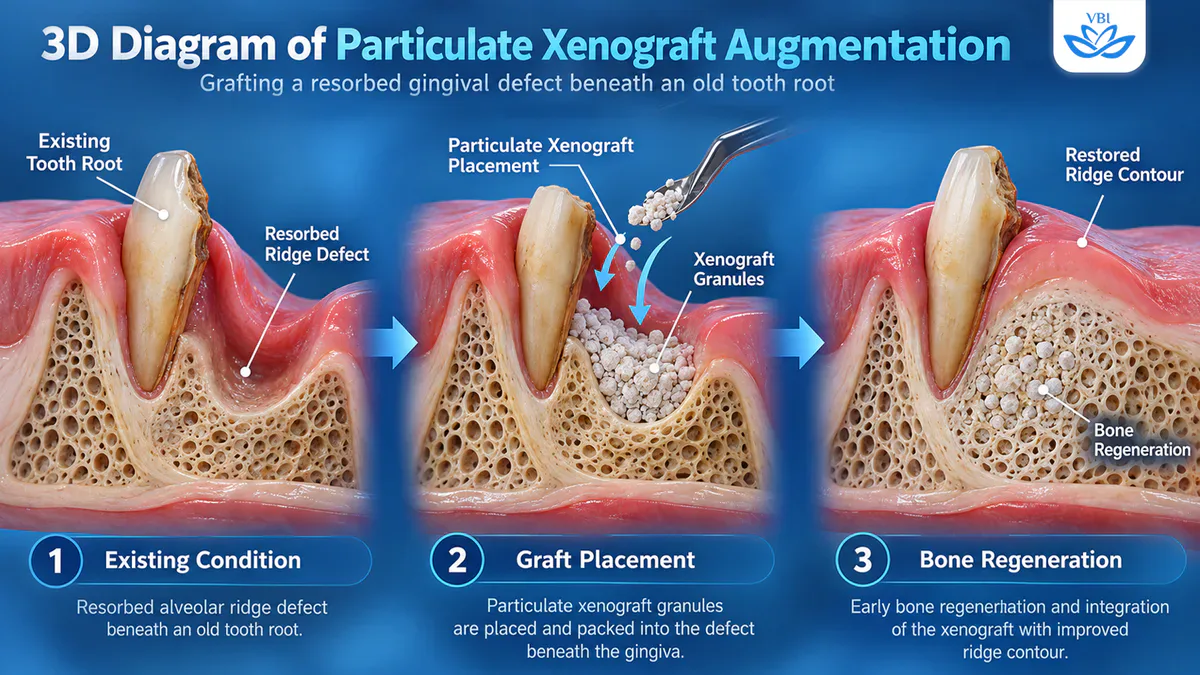
Digital 3D planning visualizes the precise granule placement required to reconstruct degraded socket walls before surgical implant placement.
Autografts: Harvesting Bone from the Patient’s Own Jaw Using Piezotome
Autografts harvest living bone tissue directly from the patient’s own body. They are clinically regarded as the biological gold standard because autologous bone contains osteogenic cells, osteoinductive signaling molecules, and a compatible osteoconductive matrix simultaneously. For localized socket preservation or minor alveolar ridge defects, surgeons harvest small bone chips from intraoral donor sites—such as the mandibular ramus or chin symphysis—using an ultrasonic Piezotome device. Piezosurgery cuts mineralized hard tissue through precise ultrasonic micro-vibrations while keeping surrounding soft nerves and vascular tissues untouched.
However, intraoral harvestable bone volume is naturally limited. For extensive horizontal ridge reconstructions or large extraoral block grafts (such as hip or tibia harvests), obtaining autologous bone requires a secondary surgical site, which increases donor-site morbidity and post-operative discomfort. Consequently, oral surgeons frequently combine or replace autografts with advanced processed biomaterials.
Allografts: Safety Standards of Certified Human Donor Bone Tissue
Allografts eliminate the need for a secondary donor surgery by utilizing human tissue sourced from certified tissue banks operating under strict American Association of Tissue Banks (AATB) and FDA safety guidelines. Donor tissue undergoes thorough serological screening, cellular removal, and terminal sterilization to remove cellular antigens and disease transmission risks.
Allografts are processed into two main clinical formulations:
- Mineralized Freeze-Dried Bone Allograft (FDBA): Preserves its inorganic mineral structure to serve as a durable, slow-resorbing osteoconductive scaffold for space maintenance.
- Demineralized Freeze-Dried Bone Allograft (DFDBA): Strips away the mineral component to expose underlying Bone Morphogenetic Proteins (BMPs). These exposed growth factors actively stimulate local host stem cells to differentiate into active osteoblasts.
Xenografts: High-Biocompatibility Bovine Bone Scaffolding for Guided Bone Regeneration
When human or autologous tissues are not preferred, xenografts derived from deproteinized bovine bone—such as Swiss-engineered Geistlich Bio-Oss—provide an exceptionally stable structural scaffold. Processed to match human cancellous bone architecture, these biological granules feature an interconnected porous network that rapidly absorbs autogenous blood and permits osteoblast migration throughout the matrix.
Because high-temperature processing transforms the natural hydroxyapatite crystals, xenograft materials resorb very slowly compared to native bone. Comparative clinical trials show that roughly 31% of grafted bovine matrix remains intact after six months, whereas autograft bone retains approximately 18% over the same timeframe. This volumetric stability makes xenografts the preferred material for maxillary sinus floor elevations and Guided Bone Regeneration (GBR) beneath protective collagen membranes.
How Synthetic Bone Grafts (Alloplasts) Offer a Modern Alternative
Alloplastic materials are completely synthetic scaffolds fabricated in controlled laboratory settings, including beta-tricalcium phosphate (β-TCP), synthetic hydroxyapatite (HA), and advanced Biphasic Calcium Phosphate (BCP) ceramics. Synthetic dental bone grafting materials completely eliminate biological disease transmission risks and ethical donor concerns while offering unlimited commercial availability.
Recent developments in low-temperature sintered BCP materials combine stable hydroxyapatite with resorbable tricalcium phosphate. Their bio-engineered micro-topography induces bone formation through physicochemical surface signaling. Modern synthetic scaffolds offer a consistent, high-purity solution for patients seeking non-animal and non-human grafting options.
Standard Healing Timelines and Recovery Tips for Dental Bone Grafting in Hanoi
Navigating the recovery time for dental implant bone graft procedures requires strict adherence to biological healing phases. The complete clinical timeline typically progresses through distinct stages:
| Healing Stage | Timeframe | Biological Activity & Surgical Milestones |
|---|---|---|
| Soft Tissue Closure | Days 1–14 | Epithelialization of suture lines; surgical swelling and minor discomfort resolve. |
| Early Matrix Vascularization | Weeks 2–6 | Capillary ingrowth into the graft matrix (angiogenesis); primary collagen network forms. |
| Osseointegration & Remodeling | Months 3–6 | Osteoblasts replace graft particles with mature woven and lamellar human bone. |
| CBCT Verification & Placement | Months 4–6+ | 3D CBCT scan confirms solid bone density before titanium implant fixture installation. |
(Note: Healing timelines vary based on individual systemic health, defect size, and biological graft type used.)
Reviewing detailed Bone graft recovery guidelines helps ensure undisturbed integration. To protect fragile graft sites during your stay in Hanoi, avoid strenuous physical activity, lifting heavy luggage, or abrupt bending for at least 7 to 10 days post-surgery to prevent elevated blood pressure from disrupting blood clot formation. Furthermore, never manipulate, massage, or apply external pressure to the surgical area.
Access Free Remote Diagnostics Before Traveling
International dental tourists from Australia, New Zealand, and Singapore can bypass diagnostic delays before flying to Hanoi. Submit your panoramic dental X-rays via our Secure OPG/X-ray Upload Portal for a free, comprehensive remote treatment plan and cost estimate tailored by our specialist clinical team.
Frequently Asked Questions About Dental Bone Graft Materials and Costs
What determines the overall bone graft cost in Vietnam?
The total cost of bone grafting in Vietnam typically ranges between $150 USD and $600 USD (approx. $230 to $900 AUD) per site. The exact price depends on the graft volume required (measured in grams or cc), the material category (synthetic alloplast vs. premium Swiss Geistlich Bio-Oss xenograft), and whether additional procedures like collagen membrane placement or sinus lift surgeries are necessary.
Are dental implants and bone grafts significantly more affordable in Vietnam than in Australia?
Yes. While Australian clinics routinely charge between $3,000 and $7,000 AUD for an implant fixture and up to $2,500 AUD for additional bone grafting, elite clinics in Hanoi offer equivalent world-class European implants and certified biomaterials at savings of 60% to 70%. These cost reductions stem from lower local operational overheads, not compromised clinical quality or sterilization protocols.
How can I submit my dental records for a pre-travel assessment?
International patients can securely transmit digital OPG X-rays or CT scans directly through our online upload portal. Our surgical team reviews your bone density levels and provides an itemized treatment schedule before you book your flights to Vietnam.
What alternative exists if my jawbone resorption is too severe for extensive grafting?
For patients with catastrophic bone loss who wish to avoid extensive sinus lifts and multi-stage surgeries, advanced full-arch protocols such as All-on-4 dental implants tilt the posterior implants strategically at 30 to 45-degree angles. This allows fixtures to anchor securely into dense anterior basal bone without requiring bone augmentation.




Bài viết liên quan
Porcelain Veneers Aftercare: Professional Tips to Extend Your Smile Lifespan
Proper porcelain veneers aftercare is the single most important factor in protecting your aesthetic investment...
Porcelain Veneers in Hanoi: Shade Selection and Material Guides for a Natural Smile
Achieving an undetectable aesthetic smile transformation begins long before ceramics are chemically bonded to tooth...
Replacing Silver Amalgam Fillings: Safe Removal Protocols for Australian Patients in Vietnam
For many patients visiting Hanoi, addressing long-standing dental concerns often includes the decision to manage...
Wisdom Tooth Extraction Recovery for Travelers: Safe Care Guidelines While in Hanoi
Navigating a dental procedure while exploring a new city requires careful planning and realistic expectations....
CBCT Scan Dental Implant Planning: Why 3D Imaging is Mandatory for Safety
Why Traditional X-Rays are Not Enough for Safe Dental Implants For patients traveling from Australia...
Piezotome Surgery Benefits: Painless Wisdom Tooth Extraction and Implants
Overcoming Fear: Modern Painless Dental Surgery is Finally Here For many patients, the mere thought...