
 Mon - Sun 8:00 - 19:00
Complete Dental Reconstruction: Understanding Your All-on-4 Hybrid Bridge Options
When planning full-arch rehabilitation, choosing the right All-on-4 bridge materials affects both your clinical biomechanics and long-term financial budget. For patients facing terminal dentition, advanced periodontal disease, or total tooth loss, a hybrid dental implant bridge offers a stable, long-lasting alternative to loose dentures. Securing a custom-designed bridge onto four strategically placed implants restores chewing function and natural facial aesthetics without the slippage associated with traditional prosthetics.
With various All-on-4 bridge materials available today, selecting between acrylic and zirconia is key to a durable smile. For international dental tourists, researching All-on-4 dental implants Vietnam is a practical path to premium restorative care. The surgical phase utilizes high-grade titanium fixtures to anchor the prosthesis securely into the jawbone. However, the final clinical outcome depends on the materials used to construct the visible bridge. Choosing between acrylic and zirconia ensures your restoration matches your bite force, joint health, and aesthetic expectations.
Material Comparison: Acrylic–Titanium Bar vs. Monolithic Zirconia
Note on Specifications: The physical and clinical behaviors detailed below represent standard material properties analyzed across clinical prosthetic dentistry; individual outcomes depend on patient-specific jaw anatomy and prosthetic design.
Evaluating the structural composition of your final hybrid prosthesis reveals fundamental differences in how these materials perform under daily chewing forces. Both options are highly successful, but they address different physiological and aesthetic priorities. Understanding the mechanical and aesthetic properties of these All-on-4 bridge materials helps patients from Australia and New Zealand make an informed decision for their oral function.
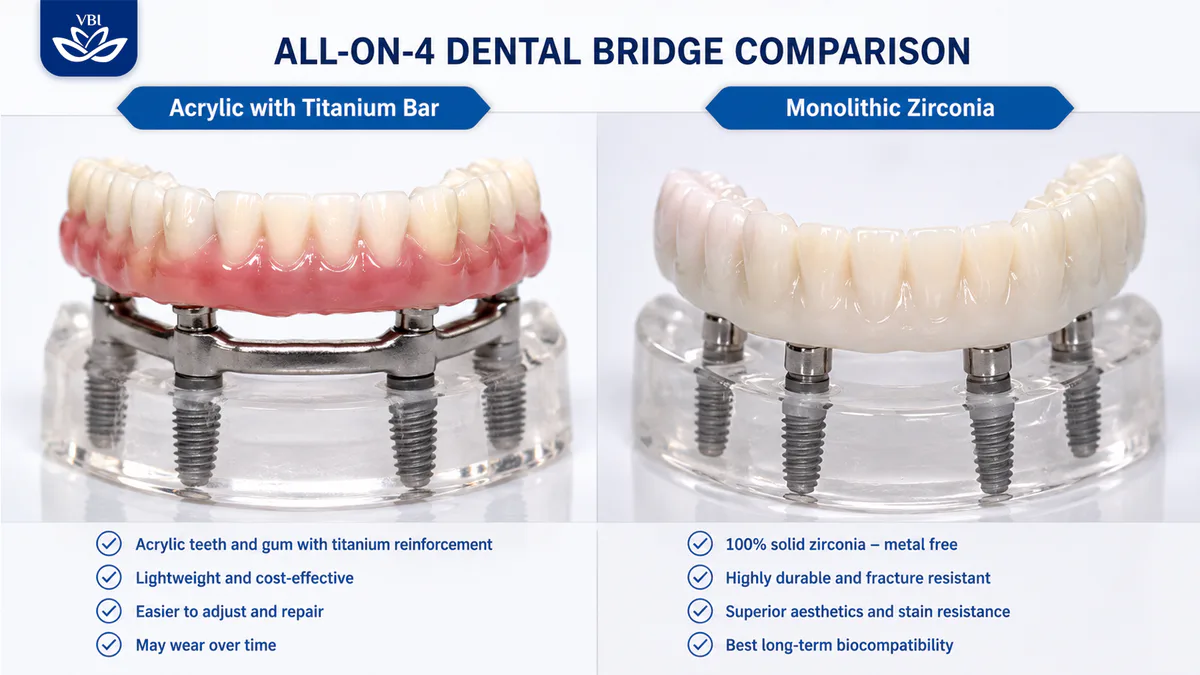
Option A: Acrylic Resin Reinforced with Titanium Bars (Biomechanical Benefits & Repairability)
As one of the most widely used All-on-4 bridge materials, the acrylic-titanium hybrid bridge is a classic restorative option. It consists of high-quality polymethyl methacrylate (PMMA) acrylic teeth bonded to an acrylic pink base, which is reinforced internally by a custom-milled medical-grade titanium bar.
From a biomechanical standpoint, acrylic has an inherent elasticity that serves as a natural shock absorber. According to the Journal of Prosthetic Dentistry in 2018, acrylic-titanium hybrid bridges are lightweight (approx. 10-15g per manufacturer specs), offering biomechanical shock absorption. This lightweight design reduces the impact forces transmitted directly to the underlying dental implants and jawbone during mastication. This cushioning effect is highly beneficial for patients with a history of bruxism (teeth grinding) or sensitive temporomandibular joints (TMJ).
Additionally, acrylic is exceptionally repairable. If you chip an acrylic tooth or wear down the chewing surface over time, a local dental laboratory can perform chairside or minor lab repairs. The technician can add new acrylic resin to the existing titanium framework within 24 to 48 hours, making maintenance straightforward and highly cost-effective.
Option B: Monolithic Zirconia Full-Arch Bridges (Aesthetics, Longevity & Weight)
Among modern All-on-4 bridge materials, monolithic zirconia represents the pinnacle of cosmetics and durability. Crafted from solid CAD/CAM-milled zirconia blocks, such as Prettau or equivalent high-translucency ceramics, this metal-free option offers exceptional aesthetics. The material mimics the natural depth, translucency, and light-reflective qualities of real tooth dentin and enamel.
Zirconia is incredibly durable. Based on Zirkonzahn Prettau Zirconia Technical Specifications in 2024, monolithic zirconia full-arch bridges exhibit a high flexural strength exceeding 1,200 MPa based on manufacturer technical data. It is virtually impervious to structural wear, chipping, and chemical staining. Unlike acrylic, zirconia will not absorb oral fluids, ensuring the restoration remains odor-free and retains its brilliant color permanently.
However, this exceptional density comes with physical trade-offs. A solid zirconia full-arch bridge is significantly heavier than its acrylic counterpart. Clinical experience shows that because zirconia is completely rigid, it does not absorb masticatory shock; instead, it transmits biting forces directly through the implant fixtures into your jawbone. Because of this, patients must have adequate bone density and a highly balanced bite. If a monolithic zirconia bridge does experience a rare catastrophic fracture, it cannot be patched or repaired easily; the entire unit must typically be remilled in a high-tech laboratory.
Bio-compatibility and Chewing Efficiency: Which Material Fits Your Oral Health?
The biological interaction of All-on-4 bridge materials with your natural tissues is critical for long-term implant survival. Solid zirconia is highly tissue-friendly, promoting healthy gum attachment and exhibiting a very low affinity for bacterial plaque. This smooth, non-porous surface makes it easier to keep clean, reducing the risk of peri-implantitis—the localized inflammatory disease that can lead to bone loss and implant failure.
In contrast, acrylic resin is slightly porous. It requires strict daily cleaning protocols, including the use of water flossers and specialized interdental brushes, to prevent plaque accumulation. Choosing the right material must balance your ability to perform rigorous hygiene with your clinical oral landscape.
In terms of chewing efficiency, both materials allow patients to regain excellent biting power compared to traditional dentures. However, they deliver different sensory experiences. Zirconia provides a highly stable, solid bite sensation that feels identical to natural teeth. Acrylic provides a softer, quieter bite, which some patients prefer as it minimizes the clicking sound sometimes associated with rigid prosthetics.
Cost Guide in Vietnam: Price Difference Between Acrylic and Zirconia Restorations
For many patients in Australia and New Zealand, the deciding factor when analyzing acrylic vs. zirconia teeth comes down to overall financial feasibility. Full-mouth reconstructions are expensive in Western countries, often forcing patients to compromise on material quality due to high retail costs. The overall investment varies depending on the specific All-on-4 bridge materials you select.
According to industry fee surveys by the Australian Dental Association (ADA) in 2025, Australian costs for full-arch hybrid restorations typically range from $20,000 to over $35,000 AUD per jaw based on industry surveys. This financial barrier makes dental tourism in Southeast Asia highly attractive.
| Restorative Phase / Option | Cost in Australia & NZ (AUD) | Cost at Viet-Bi Dental Clinic (AUD) | Average Savings (%) |
|---|---|---|---|
| Acrylic-Titanium Hybrid Bridge (Per Jaw) | $20,000 – $25,000 | $7,000 – $8,500 | 60% – 66% |
| Monolithic Zirconia Bridge (Per Jaw) | $30,000 – $35,000+ | $9,500 – $11,500 | 65% – 70% |
At Viet-Bi Dental Clinic in Hanoi, the full mouth dental implants cost is kept transparent and highly competitive. At Viet-Bi Dental Clinic, All-on-4 packages with an acrylic-titanium bridge start at $7,000 to $8,500 AUD, and upgrading to zirconia costs an additional $2,500 to $3,500 AUD. The base surgical price depends on the selected top dental implant brands in Vietnam (such as Straumann, Nobel Biocare, Osstem, or Dentium).
Upgrading your treatment to a premium Monolithic Zirconia bridge (utilizing top-tier lab materials) generally adds about $2,500 to $3,500 AUD (around $1,528 USD–$2,293 USD) to the base surgical package. This brings the complete full-arch monolithic zirconia reconstruction to a total range of $9,500 to $11,500 AUD. This structure allows patients traveling to Vietnam to access premium, metal-free zirconia restorations for significantly less than the cost of a basic acrylic hybrid bridge back home.
How Viet Bi Clinic Helps You Decide on the Ideal Full-Mouth Restoration Material
Selecting your All-on-4 bridge materials is a highly personalized process at Viet-Bi Dental Clinic. Led by our clinical specialists, our team follows a rigorous diagnostic protocol to ensure your final restoration fits your unique biomechanical profile.
- Remote Diagnostic Review: Before you leave Australia or New Zealand, you can securely upload your panoramic OPG X-rays through our secure online portal. Our specialists review your bone volume and dental history to draft an initial, obligation-free treatment plan.
- In-Depth Biomechanical Mapping: Once you arrive at one of our Hanoi locations, we conduct a comprehensive in-person assessment. We evaluate your jawbone density, joint health (TMJ), and check for signs of severe nocturnal teeth grinding (bruxism) to determine if your implants require the shock absorption of acrylic or can safely support the rigidity of zirconia.
- The Precision PMMA Try-In Phase: We do not rush the manufacturing process. Patients receive a temporary PMMA (acrylic) try-in bridge for 3 to 5 days. This clinical trial allows you to test your chewing, speech, and smile aesthetics, giving our clinical team the precise data needed to mill your final titanium-acrylic or solid zirconia bridge.
- Differentiated Warranties: We offer clear, long-term material warranties. Acrylic restorations carry a balanced warranty covering structural maintenance, while our premium monolithic zirconia frameworks feature extended multi-year warranties, backed by our leading digital laboratory partners.
If you are ready to explore your options for full-arch dental reconstruction, contact our dedicated international coordination department via our global patient email at vbivietbidental@gmail.com to begin your personalized consultation today.
Frequently Asked Questions About All-on-4 Bridge Materials
Which All-on-4 bridge materials are best for heavy teeth grinders?
For patients with severe bruxism (teeth grinding), an acrylic resin bridge reinforced with a titanium bar is highly recommended. The acrylic material acts as a shock absorber, cushioning the intense vertical and lateral forces of grinding. This elasticity helps protect the underlying dental implants and jawbone from excessive stress, reducing the risk of bone loss or mechanical implant failure.
Does a monolithic zirconia bridge feel heavy in the mouth?
Initially, yes. A monolithic zirconia bridge is denser and heavier than acrylic. However, because the bridge is securely anchored to four solid titanium implants, this weight is distributed evenly across your jawbone. Most patients adapt completely to the natural, solid feel of zirconia within two to three weeks of placement.
How often do acrylic hybrid bridges need maintenance?
Acrylic hybrid bridges typically require professional maintenance every few years. While the underlying titanium bar is permanent, the acrylic teeth and pink resin base will experience gradual wear from daily chewing and may require professional polishing or resurfacing. Viet-Bi provides personalized maintenance schedules based on each patient’s individual clinical wear patterns.
Is monolithic zirconia worth the extra cost for a full-mouth restoration?
Yes, for patients who prioritize long-term durability and premium aesthetics, monolithic zirconia is highly worth the investment. It does not stain, chip, or absorb odors, maintaining its pristine, natural appearance for decades. Additionally, its superior biocompatibility reduces plaque accumulation, making it a highly reliable and low-maintenance option for overall oral health.
References
- Journal of Prosthetic Dentistry – Biomechanical Analysis of Full-Arch Prostheses — 2018
- Zirkonzahn Prettau Zirconia Technical Specifications — 2024
- Australian Dental Association (ADA) Fee Resources — 2025
- Viet-Bi Dental Clinic International Price List — 2026
Pricing update (5 October 2026): listed clinic services follow the current USD price list. Other USD amounts are indicative conversions from previously published VND prices at 26,170 VND per USD. AUD/NZD comparisons retain the originally cited estimates and vary with exchange rates; a clinical quote confirms the final fee.




Bài viết liên quan
Professional Dental Cleaning Frequency: Long-Term Gum Health Guidelines for Expats Residing in Hanoi
Living in Hanoi as an expatriate offers a rich tapestry of experiences, from historic architecture...
Professional Teeth Whitening vs. At-Home Kits: Safety, Effectiveness, and Enamel Preservation
Achieving a bright, confident smile is a primary goal in cosmetic dentistry, yet the path...
Composite Bonding vs. Porcelain Veneers for Gap Closure: An Objective Guide for Australian Patients
For many patients in Sydney, Melbourne, or Brisbane, dealing with a prominent gap between the...
Dental Insurance Invoice in Vietnam: Expat & Tourist Reimbursement Guide
Getting dental treatment abroad can save you thousands of dollars, but navigating the administrative process...
Porcelain Veneers vs. Crowns: Enamel Preservation Comparison
When choosing between treatments, understanding the veneers vs crowns enamel preservation trade-off is vital for...
Sensitive Teeth After Laser Whitening: What to Do (Expat Guide)
Medical Disclaimer: This information is for educational purposes only and does not constitute medical advice....