
 Mon - Sun 8:00 - 19:00
When deciding between all on 4 vs 6 implants, the core difference lies in biomechanical force distribution and jawbone density requirements. The All-on-4 system uses four titanium anchors, with the back two tilted to avoid sinus cavities. This design makes it ideal for the denser bone of the lower jaw and frequently eliminates the need for complex bone grafting. Conversely, the All-on-6 protocol adds two extra vertical pillars into the jaw. This addition creates a highly stable “tripod effect” that drastically reduces biting pressure on each individual implant. Dental experts strictly mandate six implants for the upper jaw (maxilla) because maxillary bone is naturally softer and more porous. Six implants provide critical structural redundancy and prevent bone overload during heavy chewing. Ultimately, while both systems offer permanent, fixed teeth, your specific bone quality dictates the safest path. Learn exactly what is the difference between All-on-4 and All-on-6 dental implants to secure your smile’s long-term future.
The Reality of Full-Arch Tooth Replacement
Losing an entire arch of teeth is devastating. It destroys your ability to chew nutritious food, alters your facial structure, and severely damages your self-confidence. For decades, traditional removable dentures were the only option. They slip. They rub against the gums causing painful sores. They drastically reduce your tasting ability.
Modern dental implantology changed everything. Fixed, implant-supported bridges act and feel exactly like natural teeth. However, if you live in Australia or New Zealand, you already know the brutal financial reality. Advanced dental procedures are excluded from Medicare. A full-arch restoration in Sydney or Melbourne can easily drain $30,000 to $60,000 AUD from your savings or superannuation fund. This financial strain forces many patients to compromise on their treatment. We believe you should never have to choose between your life savings and your health.
When you seek treatment abroad, particularly at international clinics in Vietnam, the conversation shifts from “what can I afford?” to “what is medically best for my body?”. The central clinical debate you will face is choosing the correct number of titanium anchors to support your new teeth.
The Engineering of All-on-4 Implants
The All-on-4 technique was developed in the late 1990s as a revolutionary workaround for severe bone loss. It relies on a very specific engineering principle.
Surgeons place exactly four titanium posts into the jaw. The two front implants go in straight. The two back implants, however, are tilted backward at a sharp angle—often up to 45 degrees. This tilt is the secret to the system. By angling the implants, the surgeon can anchor them into the dense bone at the front of the jaw while completely bypassing the hollow sinus cavities at the back.
This approach offers undeniable benefits. It generally avoids painful, expensive, and time-consuming bone grafting procedures. The surgery is faster. The recovery is quicker. For the lower jaw (the mandible), which naturally possesses thick, dense bone, four implants are often more than enough to provide a lifetime of secure chewing power.
But physics has limits.
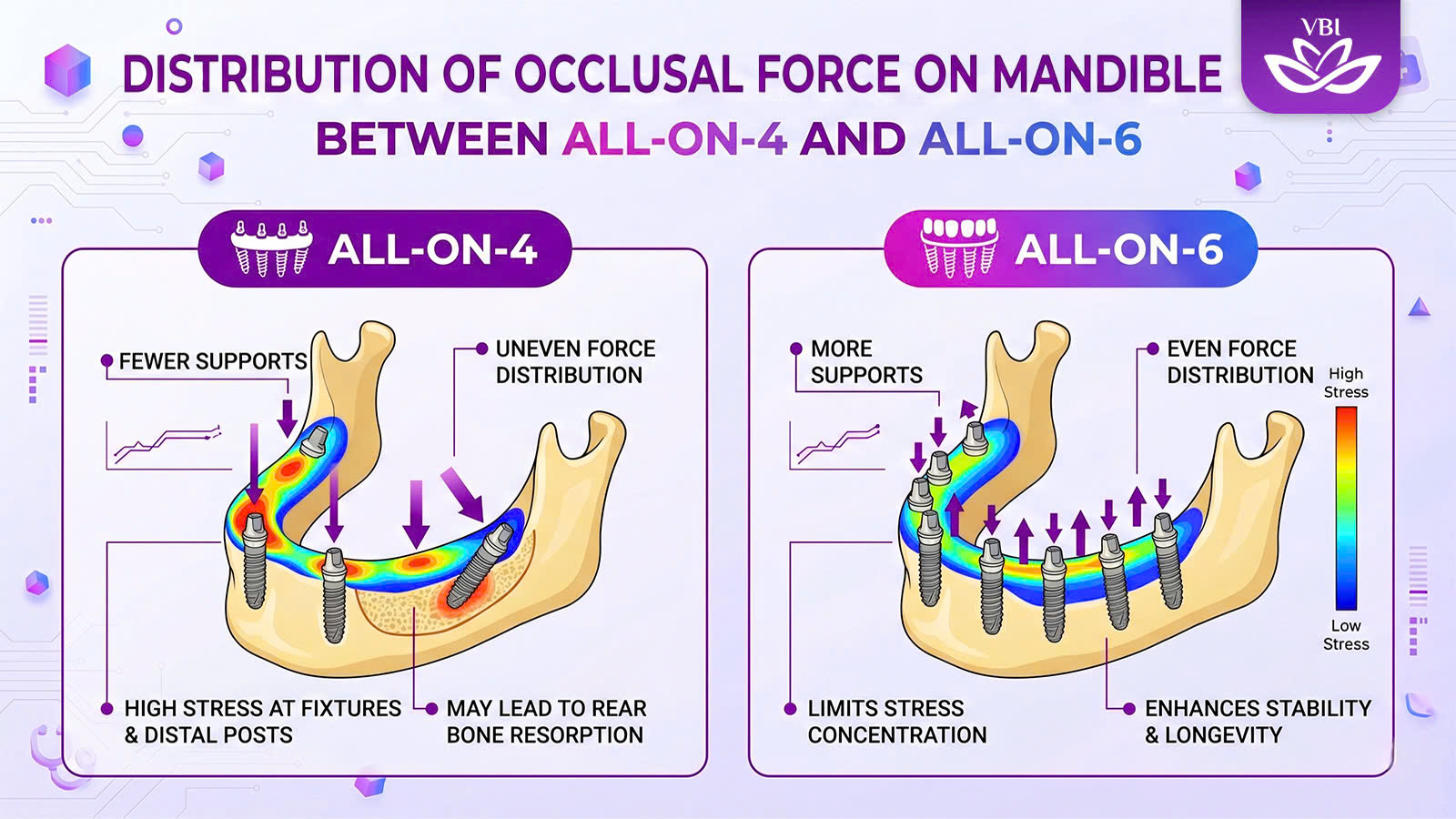
The All-on-4 system creates what engineers call a “cantilever.” A cantilever is a structure supported at only one end—like a diving board. Because there are no implants in the very back of your mouth, the back teeth on an All-on-4 bridge hang suspended. When you chew heavily on those back teeth, the bridge acts as a lever. It pulls up on the front implants and pushes down massively on the back implants. Over time, this concentrated stress can be problematic if your bone is not strong enough to handle it.
Biomechanics Comparison: The Physics of Your Bite
To fully grasp how your jaw handles the extreme forces of chewing, we must look at the science of biomechanics. The human jaw can generate up to 200 pounds of pressure in the molar regions. That force does not just disappear; it travels through the artificial teeth, down the titanium screws, and directly into your living bone.
Clinical researchers use a computational method called Finite Element Analysis (FEA) to measure this stress. FEA studies consistently reveal a stark contrast between four and six-implant setups. In a four-implant system, the highest accumulation of stress always hits the bone surrounding those angled back implants. If the bone is weak, this concentrated pressure can cause micro-fractures, leading to bone loss and potential implant failure.
Adding two more implants fundamentally alters the physics of your mouth. By extending the support further into the back of the jaw, the All-on-6 system eliminates the dangerous cantilever effect. It creates cross-arch stabilization—often called the “tripod effect.” The heavy vertical and lateral forces generated during chewing are neutralized and spread evenly across a much larger surface area.
Visualizing how chewing forces spread across your jawbone makes this engineering concept much easier to grasp. The following comparison illustrates exactly why an increased number of anchor points reduces critical stress on your skeletal structure.
Upper Jaw Solutions: Why Maxillary Anatomy Matters
We explain which is better All-on-4 or All-on-6 for the upper jaw by looking directly at human anatomy. Your upper jaw (the maxilla) and your lower jaw (the mandible) are not built the same way.
The lower jaw is a dense, heavy bone designed for crushing. The upper jaw is structurally designed to absorb shock. It is softer, more porous, and sits directly below your nasal and sinus cavities. When you lose your upper teeth, the bone shrinks rapidly, and the sinus cavities expand downward, leaving very little room for titanium implants.
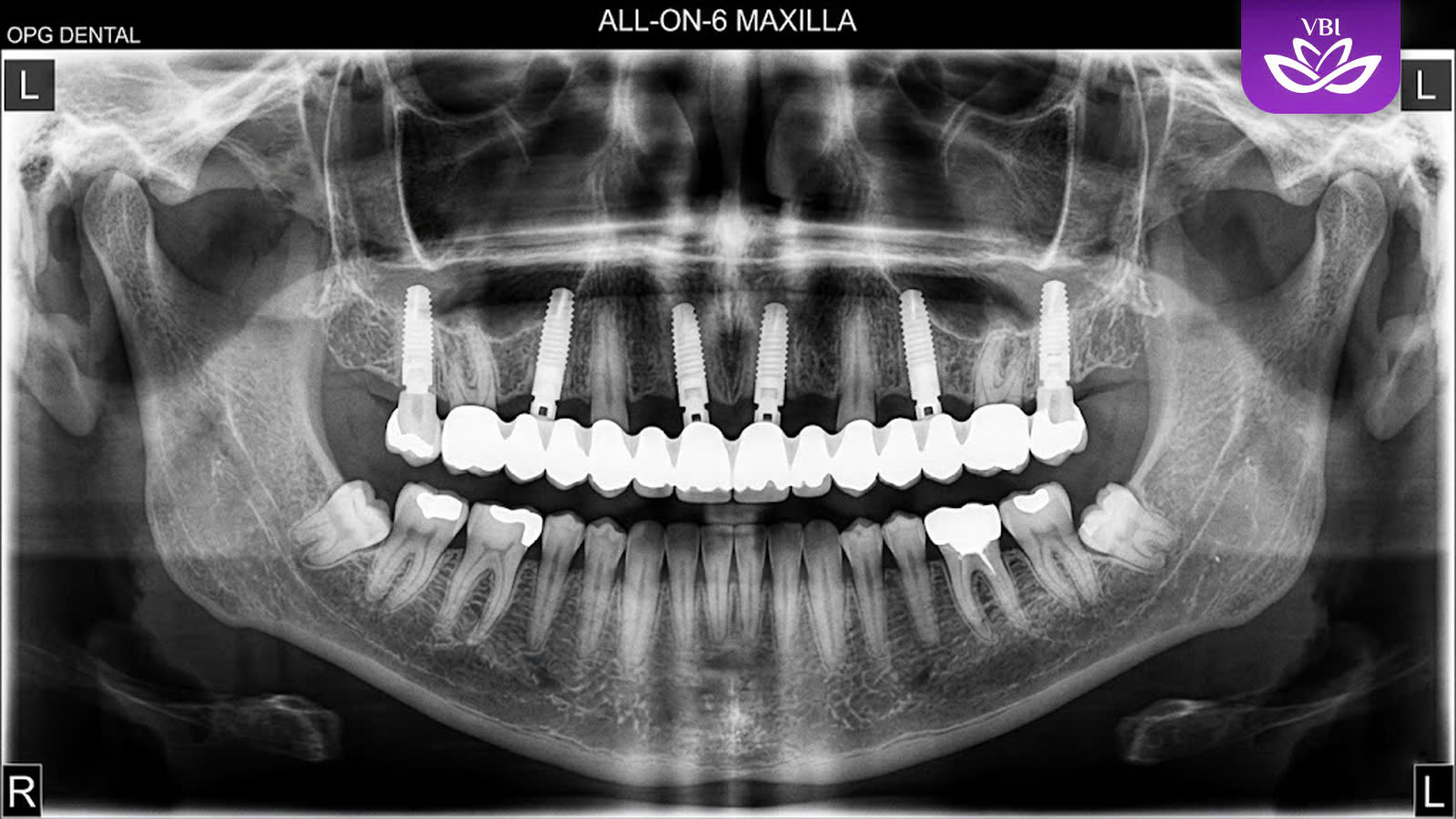
To understand what a successful outcome looks like in this complex anatomy, we can examine a real clinical radiograph. This scan shows the precise positioning of six fixtures integrated perfectly into a patient’s upper jaw.
The Lekholm and Zarb Bone Classification
To make precise surgical decisions, specialists categorize jawbone density using the Lekholm and Zarb classification system. Think of this like grading different types of wood:
-
Type 1 Bone: This is almost entirely solid, compact bone. It is extremely hard, much like oak wood. It provides incredible grip for an implant.
-
Type 2 Bone: This features a thick outer layer of solid bone with a dense, spongy core. Think of it like strong pine wood.
-
Type 3 Bone: This has a very thin outer layer of solid bone, surrounding a core of spongy, honeycomb-like bone. It is softer, comparable to balsa wood.
-
Type 4 Bone: This is the weakest type. It has a paper-thin outer shell and a very low-density, highly porous interior. Surgeons often compare drilling into Type 4 bone to drilling into styrofoam.
Here is the critical medical fact: The lower jaw is mostly made of strong Type 1 and Type 2 bone. The upper jaw, however, is almost entirely composed of weak Type 3 and Type 4 bone.
Because the upper jaw is essentially “styrofoam” bone, relying on only four implants is an enormous clinical risk. The bone simply does not have the density to withstand the leveraged forces of a cantilever bridge. Therefore, based on strict biomechanical science, an All-on-6 protocol is the mandatory medical standard for rehabilitating the upper jaw. The extra implants provide the necessary surface area to lock into the porous bone safely.
Evaluating the best implant option for full mouth Restoration
Choosing the best implant option for full mouth reconstruction requires balancing your specific anatomy with long-term security.
Beyond just handling bite force, the All-on-6 system offers something vital: clinical redundancy. Dental implants have a phenomenal success rate, often exceeding 95% over ten years. However, biological complications can occur. If an infection or heavy teeth grinding causes one implant to fail in an All-on-4 system, the entire bridge loses its foundation. The bridge must be removed, leaving you without teeth while the bone heals.
With an All-on-6 system, you have an insurance policy built into your mouth. If one implant fails, the remaining five are usually strong enough to continue supporting the bridge while the failed site is treated. This redundancy is priceless for patients who are risk-averse or those traveling internationally for care.
However, we must also consider the materials used for the final teeth. Computational studies published on the National Library of Medicine PubMed show that the material of your new teeth affects your bone. Softer frame materials (like PEEK or acrylic) actually transmit more stress down into the implants. Rigid materials, like pure Zirconia supported by a Titanium bar, act as a unified shield. They lock the six implants together into a single, immovable structure, protecting the fragile upper jaw bone from damage.
Understanding the all on 6 cost in vietnam vs Australia
For Australian patients, the decision often comes down to economics. You might understand that six implants are medically superior for your upper jaw, but you simply cannot afford the $40,000 to $60,000 AUD price tag demanded by local clinics.
This is where the transparent, premium care offered in Hanoi becomes life-changing. The all on 6 cost in vietnam at our internationally certified facility is approximately 260 million VND. When converted, this represents an investment of roughly $15,000 to $16,000 AUD.
This is not a budget alternative. This fee includes the meticulous surgical placement of six premium titanium implants, rigorous 3D CBCT scanning, surgical guides, and a highly durable Zirconia bridge. We strictly adhere to AAMI international sterilization standards, ensuring your safety is never compromised. You receive the exact same Swiss or American titanium materials used in Sydney, but at a fraction of the cost due to differing economic landscapes.
For a deeper dive into how we structure our transparent pricing without any hidden fees, you can review our comprehensive guide on Vietnam Dental Implant Costs 2026 If you are looking specifically at lower jaw solutions where fewer implants might be safely utilized, explore our detailed breakdown of All-on-4 Dental Implants in Hanoi.
Take the Next Step Toward Your New Smile
Your jawbone is unique. It requires a personalized, data-driven approach, not a one-size-fits-all sales pitch. The only way to definitively know whether an All-on-4 or an All-on-6 system is right for you is through a comprehensive 3D radiographic assessment.
We invite you to securely send your dental X-rays or CBCT scans to our English-speaking medical team. Our elite specialists will analyze your bone density, evaluate your sinus cavities, and calculate your bite force. We will then provide you with a transparent, personalized treatment plan that prioritizes your long-term health and safety above all else.
Contact our specialists today to begin your journey toward a confident, permanent smile.




Bài viết liên quan
CBCT Scan Dental Implant Planning: Why 3D Imaging is Mandatory for Safety
Why Traditional X-Rays are Not Enough for Safe Dental Implants For patients traveling from Australia...
Piezotome Surgery Benefits: Painless Wisdom Tooth Extraction and Implants
Overcoming Fear: Modern Painless Dental Surgery is Finally Here For many patients, the mere thought...
Digital Smile Design in Hanoi: Preview Your Dream Smile Before Treatment Starts
For many international patients from Australia, New Zealand, and local expatriates in Vietnam, the decision...
Laser Teeth Whitening in Hanoi: Safe, Rapid & Bright Results
Achieve a brilliant, photo-ready smile with our professional teeth whitening hanoi services, completed in just...
Painless Teeth Scaling in Hanoi Old Quarter: Viet Bi Premium Experience
Disclaimer: This content is for informational purposes only and does not constitute professional medical advice....
How Long Do Implants Take? 7 Essential Timeline Facts
Patients frequently ask how long do implants take from the initial surgery to the final...